SAC Catalogue Metadata Schema — AstraZeneca
Designing the metadata schema and governance process that made thousands of SAC dashboards findable and trustworthy — from ten stakeholder research interviews through a facilitated workshop, three rounds of iteration, and an operational submission template now in active use.

The Problem
Before SAC, AstraZeneca's analytics teams around the world operated across a wide range of tools — Power BI, ClickView, Snowflake-based models, and others — each with its own naming conventions, folder structures, and working habits. When everything converged onto one platform, none of that transferred cleanly. There was no shared business glossary, no agreed naming structure, and no consistent way to organise or tag reports and dashboards. The same word meant different things in different functions.
The result was a catalogue that people couldn't trust or rely on. Dashboards had ambiguous titles, or no descriptive context at all. Duplicate and outdated reports sat alongside current ones with nothing to distinguish them. Ownership information went stale. Users built personal workarounds — bookmarks, browser pins, links in Word documents — because there was nothing reliable to search. The question this project set out to answer was: what information does a dashboard need to carry about itself so that thousands of reports across a global organisation can be found, trusted, and used correctly?

My Role
I was the sole UX resource on this project end to end. I planned and conducted all ten stakeholder interviews, designed and facilitated the workshop used to define and prioritise candidate metadata fields, led the iterative design of the schema across multiple rounds, and built the final operational submission template and governance flow used to publish dashboards into the catalogue.
The Approach
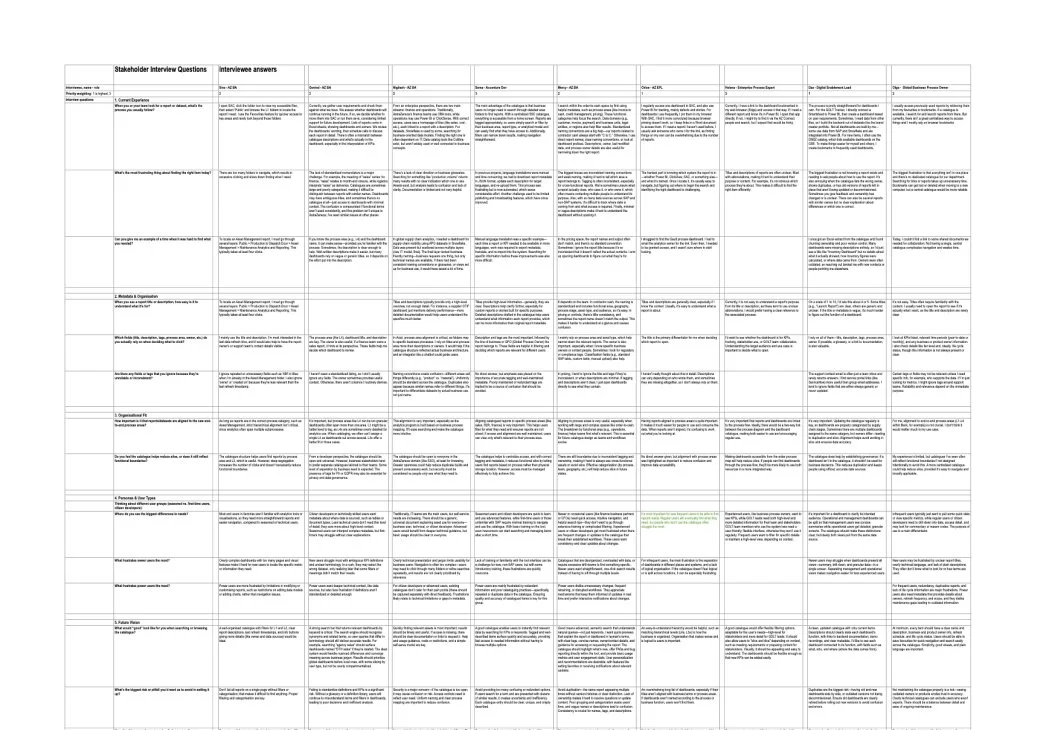
I started with research rather than a starting schema. Ten interviews across AstraZeneca BAs, an Accenture developer, Enterprise Process Leads and Experts, a Digital Enablement Lead, and a Global Business Process Owner surfaced a consistent set of pain points: inconsistent naming and tagging, no centralised catalogue, poor or outdated metadata, duplicate and un-decommissioned reports, and navigation buried under too many folder layers.
That research fed directly into a workshop with stakeholders to define and prioritise the metadata fields that would make up the schema. To get a room of business and technical stakeholders onto the same page quickly, I built a short teaching exercise around film and TV metadata examples, asking participants to sort plain-language examples into description, filter, or tag. Anchoring an abstract IA concept in something familiar meant the group could engage productively rather than getting stuck on terminology.
The schema then went through several rounds of iteration — drafted from the interviews, refined in the workshop, then tested in follow-up calls with BAs applying it to real dashboards. Each round surfaced practical decisions: should Process Area be a multi-tag rather than a single filter? Should ownership be split into separate technical and business contacts? Working through these with the people who'd actually use the schema turned a reasonable first draft into something fit for purpose.
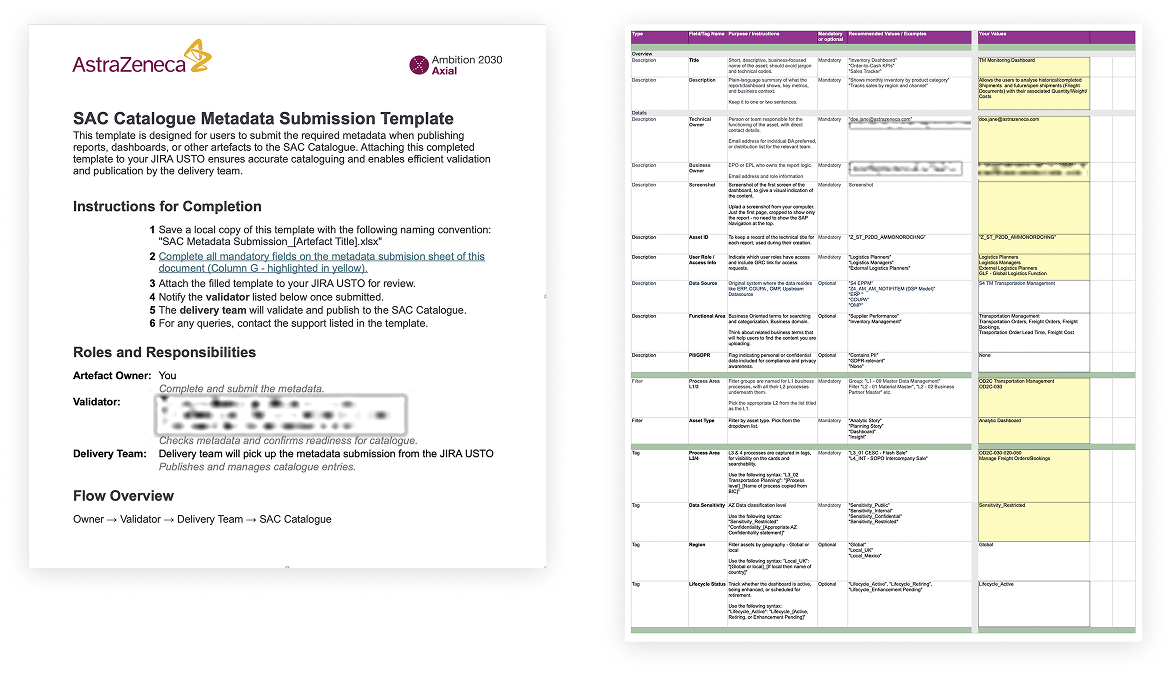
The final schema organised fields into description, filter, and tag types, mapped to AstraZeneca's process architecture and data sensitivity classifications. I then built it into an operational submission template with mandatory fields, recommended values, and a defined governance flow — owner, validator, delivery team — attached to the JIRA publishing process so metadata submission was embedded in delivery rather than bolted on as a separate step.
The Outcome
The schema and submission template are in active use for publishing dashboards into the SAC Catalogue. The work moved from a research question to a governed, repeatable process now embedded in AstraZeneca's standard delivery workflow — directly addressing the naming inconsistency, missing ownership, and untrustworthy metadata that the original interviews identified as the core barriers to a usable catalogue.